
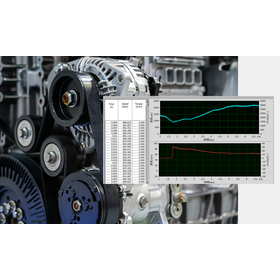
Crankshaft simulation test
Moving away from engine testing, reproducing vehicle launch behavior on a test stand.
The company introducing this case study is a major automotive OEM with a presence overseas. This company is engaged in durability and performance testing that replicates the behavior during actual vehicle operation in the department responsible for the development and evaluation of drive system components such as auxiliary devices and belts around the engine. They faced challenges in reproducing the load behavior that occurs during vehicle launch when evaluating drive system components like auxiliary devices and belts around the engine. The crankshaft experiences periodic fluctuations in speed and torque due to the combustion motion of the piston. Particularly during vehicle launch, these fluctuations are significant, placing a heavy load on the belts and auxiliary components. However, traditional testing environments have been limited to constant-speed rotation or controlled patterns, making it difficult to adequately replicate such unsteady rotational behavior. Seagull Co., Ltd. proposed an extension of control functions through software modifications to establish a test environment that can replicate the evaluation of drive system components like auxiliary devices and belts, which had relied on engine-based testing. The core of this proposal is a control technology that utilizes rotation data from the crankshaft obtained during actual vehicle operation, including the unsteady speed fluctuations that occur during vehicle launch.
- 企業:Siigoto, Inc.
- 価格:Other
